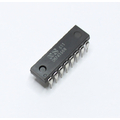
TCA440 AM receiver (HF-IF-demodulator) DIP16
Description
TCA440 AM Receiver (RF ? IF ? Demodulator Circuit) DIP16
The TCA440 is a classic bipolar monolithic integrated circuit (IC) for AM receivers, originally developed by Siemens (later Infineon). It integrates the essential stages of an analog superheterodyne receiver?covering long-wave, medium-wave, and short-wave (LW, MW, SW) bands up to frequencies of approximately 30 to 50 MHz?onto a single chip.
In the GDR, this component was manufactured under license (or as an equivalent) with the designation A244D.
Main Functions and Internal Structure
The circuit is housed in a DIP-16 package and combines the following functional units:
The TCA440 is a classic bipolar monolithic integrated circuit (IC) for AM receivers, originally developed by Siemens (later Infineon). It integrates the essential stages of an analog superheterodyne receiver?covering long-wave, medium-wave, and short-wave (LW, MW, SW) bands up to frequencies of approximately 30 to 50 MHz?onto a single chip.
In the GDR, this component was manufactured under license (or as an equivalent) with the designation A244D.
Main Functions and Internal Structure
The circuit is housed in a DIP-16 package and combines the following functional units:
- Controlled RF Pre-stage (RF Stage): Amplifies the antenna signal and features automatic gain control (AGC/AVC) with high large-signal handling capability to prevent overloading.
- Multiplicative Balanced Mixer: Mixes the RF input signal down with the oscillator signal to generate the intermediate frequency (IF). Multiplicative mixing minimizes unwanted harmonics and spurious whistles.
- Separate oscillator: Generates the internal frequency required for mixing. Regulated, multi-stage IF amplifier: Provides high gain for the intermediate frequency (typically 460 kHz or 455 kHz).
- Field strength indicator connection: Supplies a direct output current to drive an analog moving-coil meter (S-meter).